

Agent Customization
Switch to Agent Customization view using the
icon in the main menu.
The Agent Customization view allows you to manage default agent and models, reusable prompts, and agent instructions. This is useful for customizing the behavior of the AI Agent.
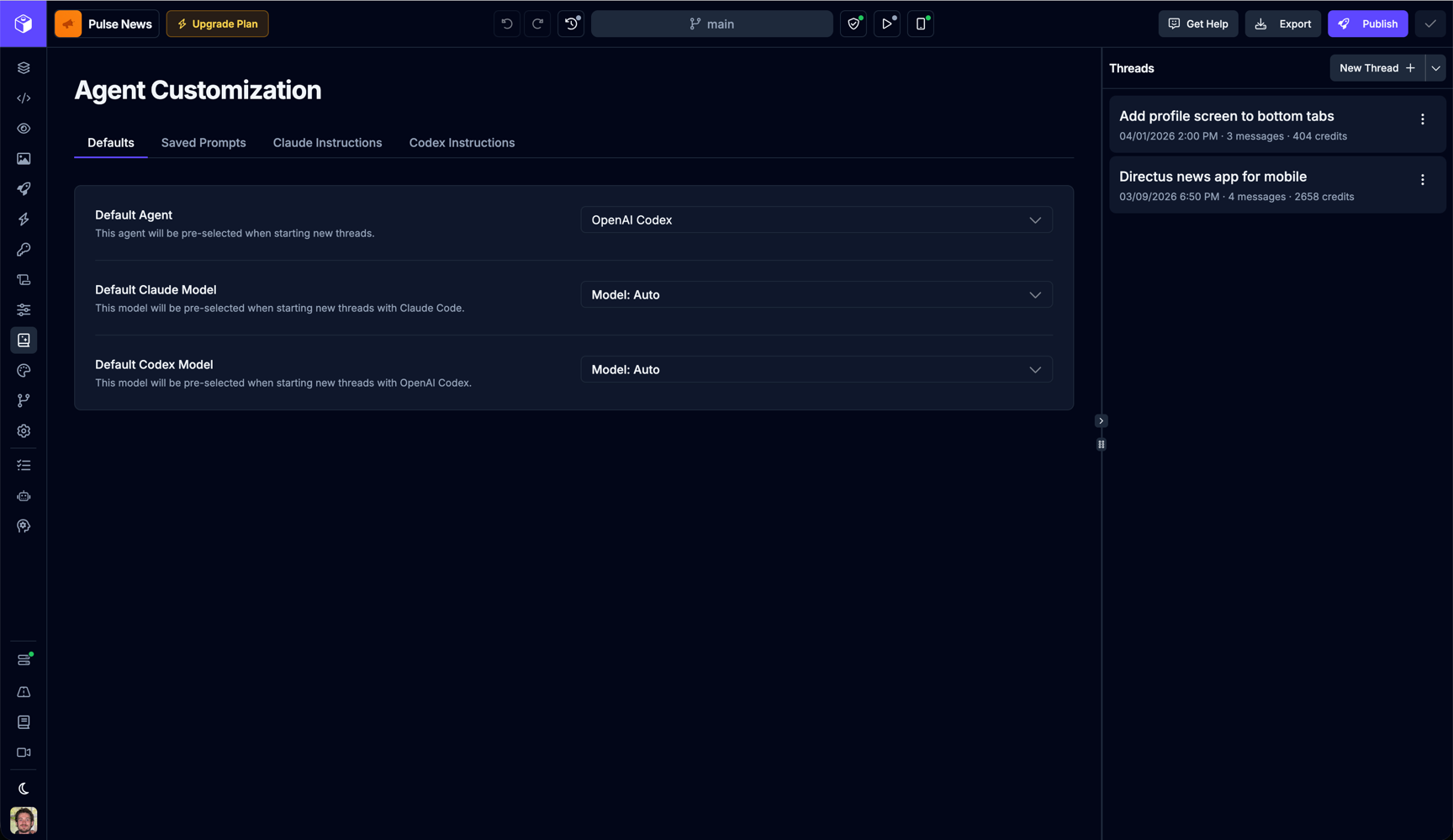
Defaults
Section titled “Defaults”If you have a preferred agent, model, and AI gateway combination you like to work with, you can set it as the default here. These defaults are automatically selected when starting a new chat thread. You can always change them when sending a new message in the AI Chat tab.
| Name | Description |
|---|---|
| Agent | The agent that will be automatically selected for new chat threads. |
| Claude Model | The Claude model automatically selected when using the Claude agent (Claude Opus 5.5 by default). |
| Codex Model | The OpenAI Codex model automatically selected when using the Codex agent (GPT-6.1 Sol by default). |
| AI Gateway | The billing path or provider used for new threads, such as Draftbit credits, OpenRouter, OpenAI, Anthropic, or a connected subscription. |
You can also select Claude Sonnet 5.5 or Claude Haiku 5.5 in the Claude model picker. Claude Opus 5.5 remains the default.
OpenRouter also offers DeepSeek V4.1 Flash, DeepSeek V4 Pro 0813, Muse Spark 1.3, Grok 4.7, MiMo V2.6 Pro, Qwen3.8 Max, GLM 5.3, Gemini 3.8 Flash, and Kimi K3. Select a model in Agent settings or the chat model picker.
Security Review also starts a new thread using these defaults, including when you launch it from an existing chat. The action becomes available once the settings have loaded and a compatible model is available.
Bring Your Own Key or Subscription
Section titled “Bring Your Own Key or Subscription”Agent Config is also where you connect your own AI provider access.
Supported options include:
- OpenRouter API keys
- OpenAI API keys
- Anthropic API keys
- OpenAI subscriptions
- Claude subscriptions
- Codex subscriptions
Threads that use your own key or subscription run through that provider instead of consuming Draftbit credits. Draftbit shows the selected provider in chat and thread history so you can tell which billing path a thread is using.
If a connected key or subscription hits its usage limit, the chat shows a provider-specific recovery message instead of a generic agent failure.
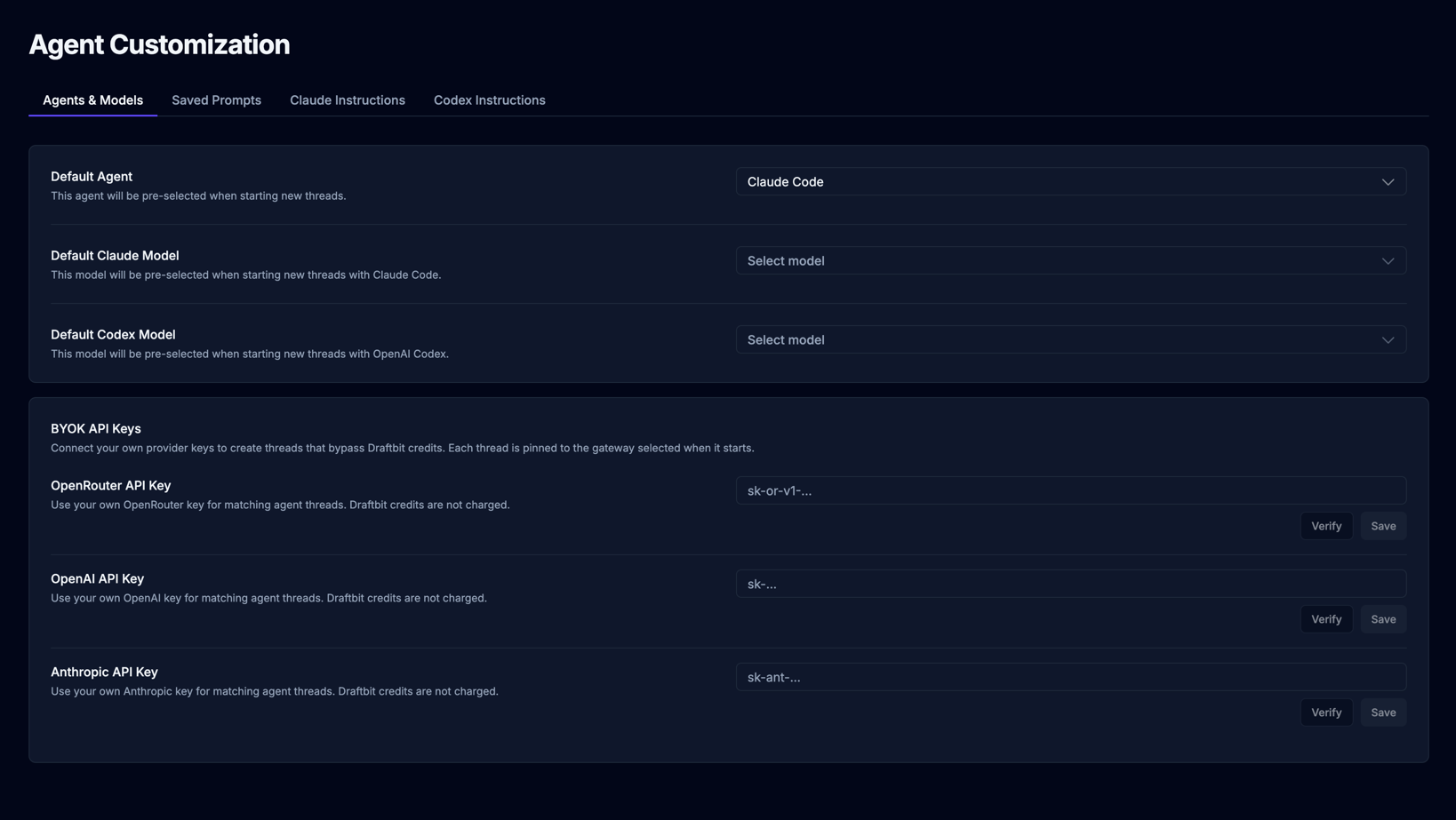
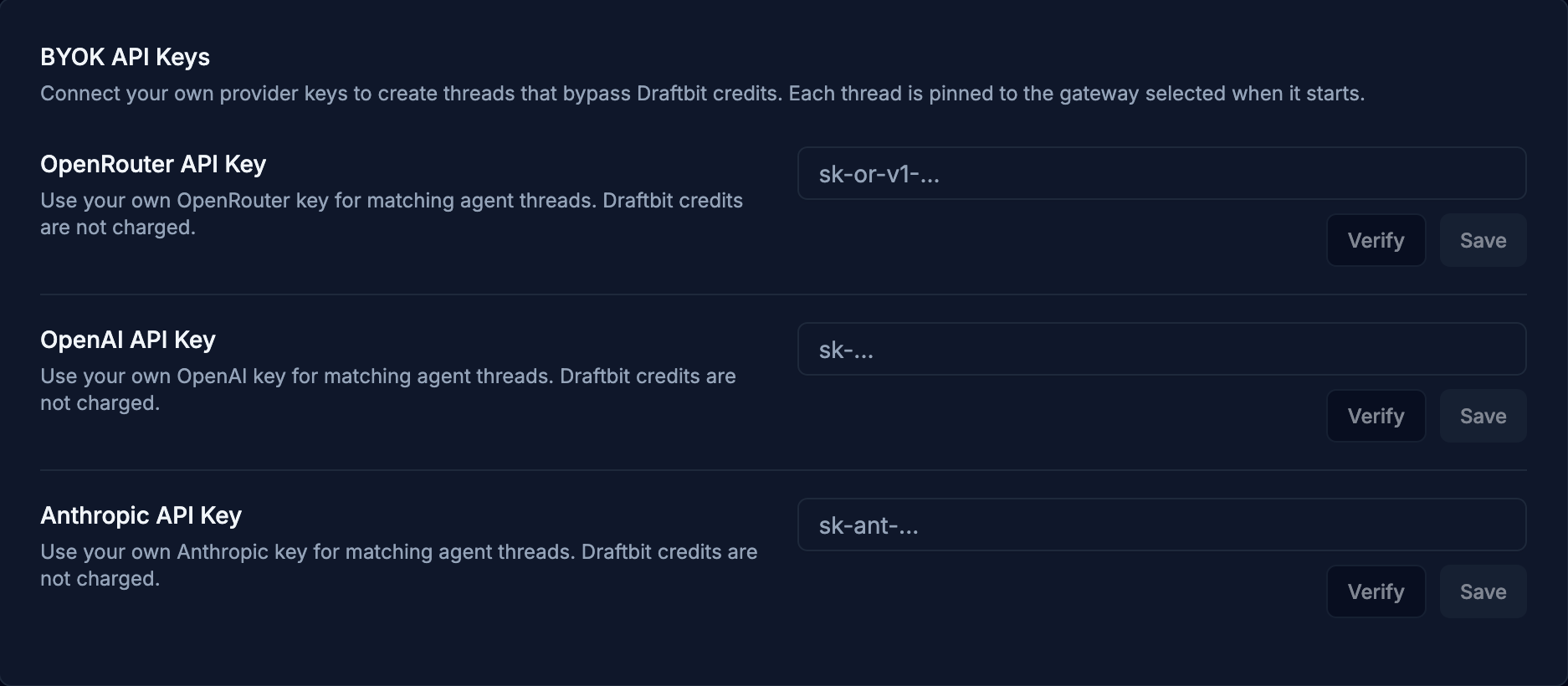
Provider Keys (BYOK)
Section titled “Provider Keys (BYOK)”You can connect your own AI provider API keys and have agent runs route directly to that provider instead of through Draftbit credits. This is available on every plan, including Free.
Supported providers
Section titled “Supported providers”| Provider | Where to create a key |
|---|---|
| OpenAI | platform.openai.com/api-keys |
| Anthropic | console.anthropic.com/settings/keys |
| OpenRouter | openrouter.ai/settings/keys |
How it works
Section titled “How it works”- Connect a key under Defaults → Provider Keys. Once connected, the corresponding models can be selected as your default or chosen ad‑hoc when sending a message.
- Threads using your key route directly to the provider and bypass Draftbit credits entirely. You’ll see provider labels in chat and in your thread history so it’s always clear where a request is going.
- You can still mix Draftbit‑credit threads and BYOK threads in the same project — the provider used is recorded per‑thread.
- Rate limits and model availability are governed by your provider account, not Draftbit. If a request fails because of provider limits or expired keys, the error surfaces inline in the chat.
If your OpenRouter key has no available models, open Agent settings to review the key’s limits or choose another AI gateway. If subagent options cannot load, retry or choose Automatic.
For more on how this affects billing, see Credits and Using Credits Efficiently.
AI Provider Subscriptions
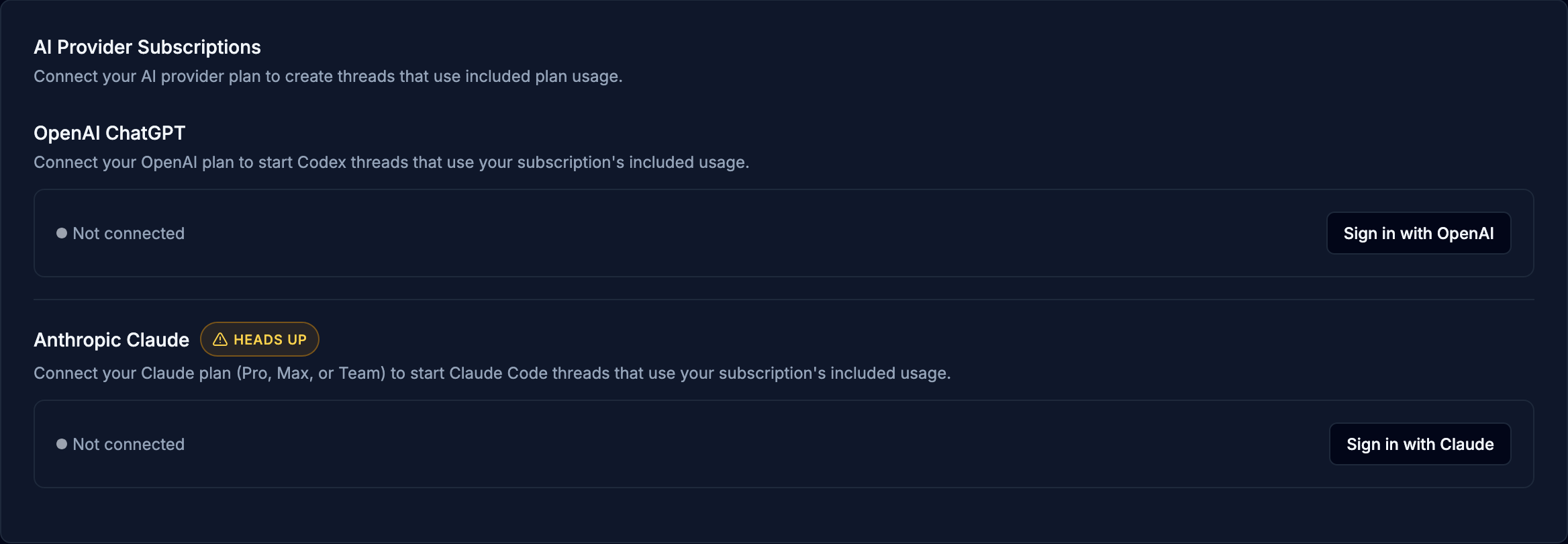
Section titled “AI Provider Subscriptions”In addition to API keys, you can connect an AI provider subscription plan so that agent threads use your plan’s included usage instead of Draftbit credits or a metered API key.
| Provider | Button | What it connects |
|---|---|---|
| OpenAI ChatGPT | Sign in with OpenAI | Starts Codex threads that use your OpenAI subscription’s included usage. |
| Anthropic Claude | Sign in with Claude | Starts Claude Code threads that use your Claude plan’s (Pro, Max, or Team) included usage. |
Click Sign in with OpenAI or Sign in with Claude and complete the provider’s authorization flow. Once connected, the status changes from Not connected to show the connected account, and new threads for that agent can draw from the subscription’s included usage instead of Draftbit credits. A connected ChatGPT subscription also shows its plan, such as ChatGPT Plus.
If an API key is removed while you are composing a message, Draftbit keeps your draft and selected gateway. Select the warning icon beside AI Gateway to open Agent settings or Retry the check, or select another gateway before sending.
When you select a subscription in the new-thread composer, Draftbit checks its connection before enabling Send. If the connection needs attention, the composer keeps your selected subscription and draft. A spinner beside the provider means the connection is being checked; a green check means it is ready. Hover over or focus the status icon for details. If a subscription check takes longer than 15 seconds, Draftbit stops waiting and shows an amber warning. Select the warning icon to choose Retry or Open settings. To use Draftbit credits instead, select Draftbit (Credits) from AI Gateway yourself.
If a new thread asks you to reconnect your subscription, choose Open settings in the error message. Reconnect the matching provider under AI Provider Subscriptions, then return to your draft and try again. If Draftbit cannot verify the subscription, check the connection in settings before retrying. Your unsent message and attachments stay in the composer.
If a ChatGPT thread shows Reconnect ChatGPT, OpenAI rejected the connection when the run started. Choose Open settings, sign out of the affected ChatGPT connection if it still shows as connected, then sign in again and retry your message. The button opens app Agent settings for an app connection, or organization AI Providers settings for a shared connection if you’re an organization admin or owner. Other editors can ask an organization admin to reconnect the shared subscription or connect their own in app Agent settings.
If a ChatGPT thread says a model isn’t available on your ChatGPT plan, OpenAI didn’t let your plan run that Codex model. Pick a different model in the thread and send your message again. To keep the model, start a new thread and select Draftbit (Credits) from AI Gateway.
The Heads Up badge next to Anthropic Claude notes that Claude.ai connectors and Remote Control aren’t available when using your Claude subscription in Draftbit, and that usage remains subject to Anthropic’s policies. See Claude authentication for more.
Organization-Wide AI Providers
Section titled “Organization-Wide AI Providers”Everything above can also be set once at the organization level instead of per app. Go to Organization → AI Providers to connect subscriptions or API keys for the whole organization — every project can use them immediately, with no individual setup, and the rest of your team benefits automatically.
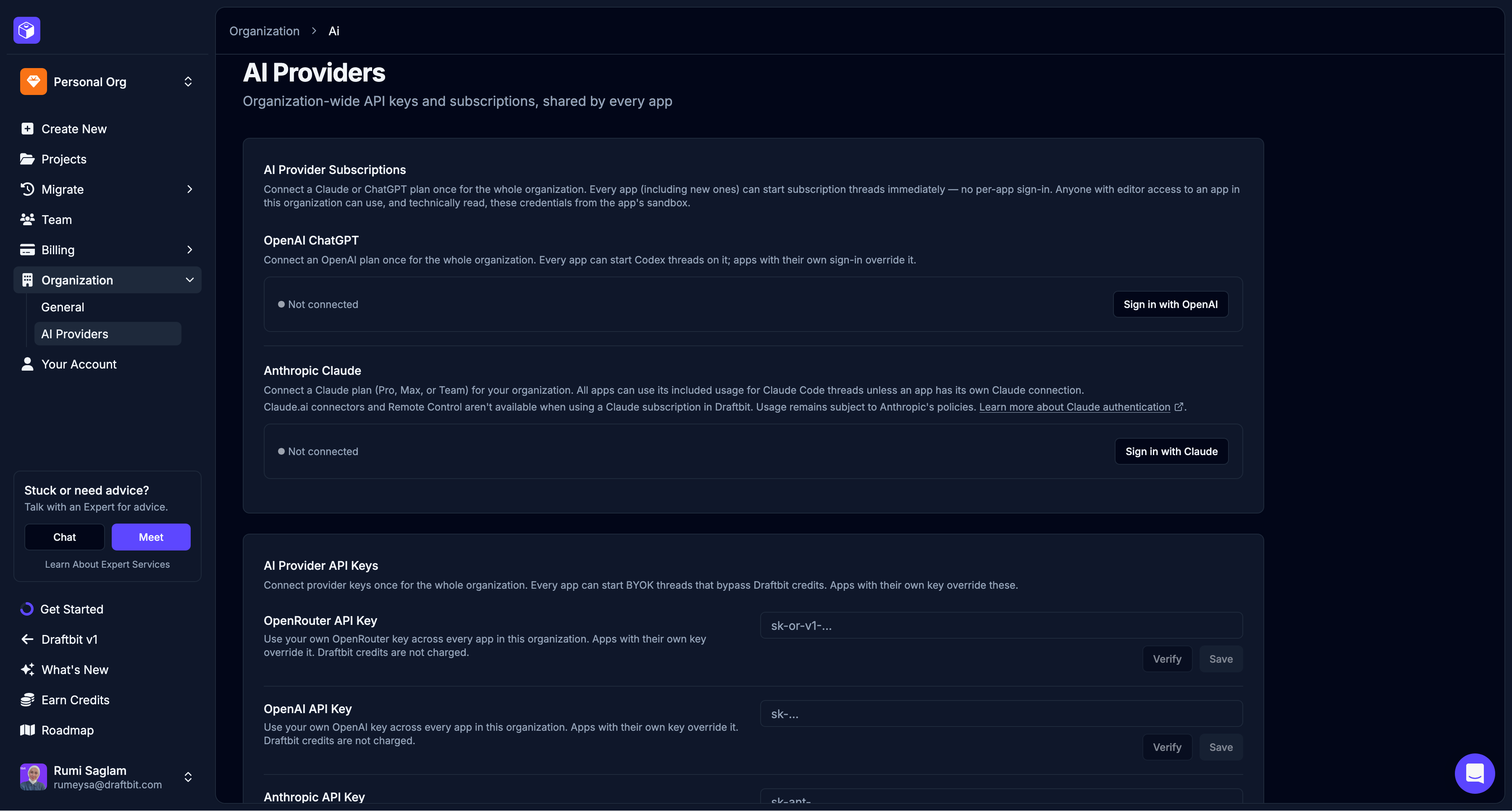
This page has the same two sections as an individual app’s Agent Config, but scoped to the organization:
| Section | What it does |
|---|---|
| AI Provider Subscriptions | Connect a Claude or ChatGPT plan once for the whole organization. Every app (including new ones) can start subscription threads immediately — no per-app sign-in. |
| AI Provider API Keys | Connect OpenRouter, OpenAI, or Anthropic keys once for the whole organization. Every app can start BYOK threads that bypass Draftbit credits. |
A few things to know:
- Only organization admins and owners can manage this page. Other members see a message pointing them to an admin, or to set app-level keys instead from an app’s Agent Config.
- App-level connections always override organization-level ones. If an app has its own key or subscription connected, it uses that instead of the organization’s.
Saved Prompts
Section titled “Saved Prompts”Switch to Saved Prompts view using the
tab.
Saved Prompts are reusable prompts that you can use when sending a message to the agent. They can be used to set the context for the agent’s response or to provide additional instructions for the agent to follow.
Creating a New Prompt
Section titled “Creating a New Prompt”Create a new prompt by clicking the  button.
| Input | Description |
|---|---|
| Name | The name of the prompt. |
| Prompt | Description of the prompt. |
Fill in the details for the prompt and click the  button.
Editing a Prompt
Section titled “Editing a Prompt”Edit a saved prompt by clicking the  button.
| Input | Description |
|---|---|
| Name | The name of the prompt. |
| Prompt | Description of the prompt. |
Fill in the details for the prompt and click the  button.
Deleting a Prompt
Section titled “Deleting a Prompt”Delete a saved prompt by clicking the  button.
Using a Saved Prompt
Section titled “Using a Saved Prompt”You can use a saved prompt by clicking the  button in the AI Chat tab.
Agent Instructions
Section titled “Agent Instructions”You can customize the system prompt that Draftbit attaches to each agent when it starts a new chat thread. This is useful for telling the agent about your project’s tech stack, conventions, and key files.
Each agent has its own dedicated instructions file:
| Agent | File | What it controls |
|---|---|---|
| Claude | CLAUDE.md | System prompt added to every Claude Code agent thread. |
| Codex | AGENTS.md | System prompt added to every OpenAI Codex agent thread. |
Open the file for the agent you want to configure, edit it inline, and save. The instructions take effect on the next thread that agent starts. The Instructions Agent sidebar on this page can also help you draft and refine these files conversationally.
Best practices
Section titled “Best practices”- Focus on providing details the agents need to know about the tech stack, conventions, and key files of your project.
- Set any conventions or rules you want the agents to follow, for example “always use the existing component library before creating new components”.
- Don’t include future plans or ideas for the project. This is just base knowledge.
- Provide only the critical details and aspects of your project. Adding too much information can overwhelm and slow down the agent’s performance, while also driving up cost of each request. Experiment to find the right balance.